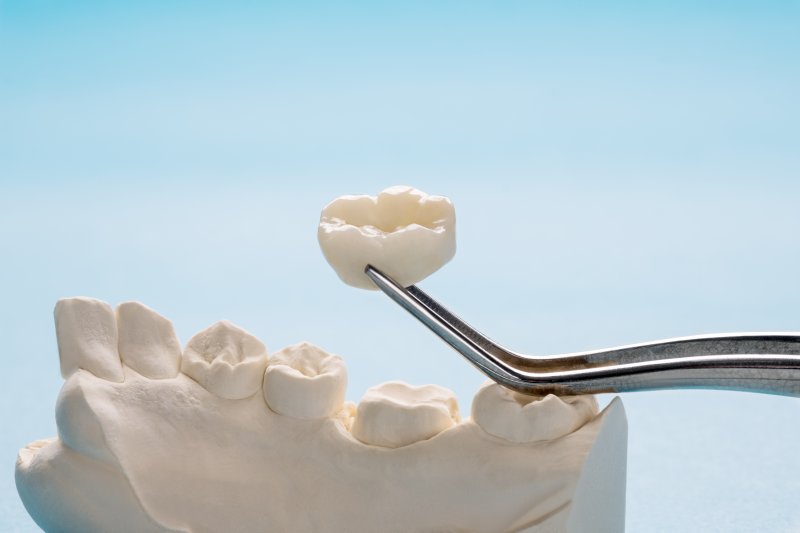
Since dental crowns have had their current form for decades, it’s easy to think they’ve always used the same design and makeup. You might even assume their modern form is “obvious” or “self-evident.” Even so, the history of dental crowns shows quite a different story. The caps we take for granted took many centuries to reach their present state, and those years involved much effort and ingenuity. For more details, just read this primer on dental crowns’ development.
A Start in the Ancient Era
Dental crowns didn’t start as the well-researched caps we know now. Instead, they first emerged – along with the rest of dentistry – in humanity’s ancient era.
This conclusion is backed by the most recent archeological evidence. For example, scholars have found remnants suggesting that Etruscans developed dental crowns in the 7th century BCE. These “proto-crowns” didn’t fix broken or decayed teeth, but instead made wealthy citizens’ smiles look eye-catching. After all, the main material used was gold – a major status symbol, not something known for oral protection.
Minor Progress in the Middle Ages
Thankfully, people became more hygiene-focused by the Middle Ages. This shift led to positive changes in how dental crowns were made.
These advancements mainly occurred in 15th-century Europe. Indeed, the first book about dentistry that covered fillings and crowns was written in 1530 CE. The doctor Ambrose Pare later wrote about the technical details of dental crowns in his “Complete Works,” published in 1575. For that latter book, the future “Father of Surgery” discussed jaw fractures, tooth decay treatments, and more.
Modernity’s “Scientific” Dental Crowns
Dental crown breakthroughs didn’t stop in medieval times. On the contrary, they picked up speed years later in the 19th and 20th centuries.
The proof comes in the form of a few famous dental figures. Around the late 1800s, Dr. Charles H. Land patented the porcelain “jacket” dental crown. This type was then surpassed by the porcelain-fused-to-metal (PFM) cap in the early 1900s. Unlike Land’s creation, the PFM crown offers lifelike results due to porcelain’s natural beauty and a metallic base’s durability.
Dental Crowns of the Present-Day
Finally, dental crowns began to take their present form in the early 21st century. Insights from earlier years have made the modern caps readily available and highly effective.
The most recent crown developments rely on cutting-edge technology. For instance, many tools now let dentists make restorations from pure porcelain, zirconia, and similar materials. Digital impressions also let dental teams tailor crowns to fit teeth more precisely.
As easy as it looks now, today’s tooth repair depends on the long history of dental crowns. Appreciate that storied development the next time you get treatment.
About the Practice
Kessler Park Dental is based in Dallas, TX. Led by Dr. Jayme Martinez, our practice always aims to make your appointments comfortable, convenient, and effective. We thus provide a wide range of tailored dental treatments, as well as amenities like mounted TVs and free Wi-Fi. Naturally enough, we include high-quality dental crowns among these stellar offerings! For more details or to book a visit, please contact us on our website or by phone at (214)-303-9969.